Freeze frame data explained
Quick answer
Freeze frame is a snapshot of every monitored sensor value, including engine speed, load, coolant temperature, fuel trim and vehicle speed, captured at the exact instant a trouble code set, and it exists specifically to preserve the conditions under which the fault occurred even after the vehicle returns to normal operation.
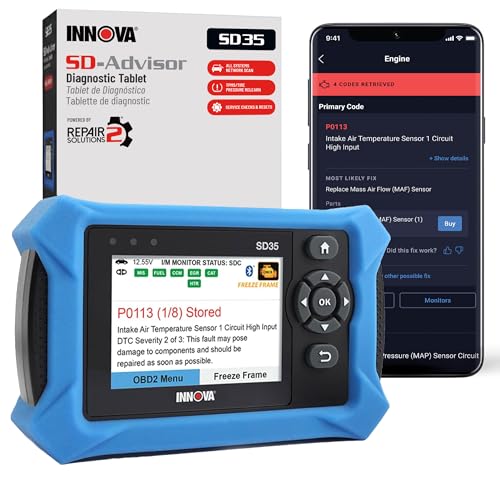
Innova SD35 OBD2 Scanner, ABS, SRS, TPMS & Check Engine Code Reader, Live Data, All System Diagnostics, Compatible with Most Vehicles
A scanner that displays live data alongside stored codes is the tool that also exposes freeze frame records, letting you see the exact conditions present when a fault occurred rather than only the code number itself.
Coverage varies by tool and by model year, so check a specific tool against a specific vehicle before buying.
What freeze frame data actually is
When the powertrain control module confirms a trouble code, it does more than just store the code number. It also captures and freezes a set of sensor readings from the moment the fault was detected, essentially a snapshot of the engine's operating state at that instant. That snapshot is what freeze frame data is.
Most vehicles store one freeze frame per trouble code, though priority rules vary by manufacturer, and a more serious fault can overwrite an existing freeze frame if memory is limited. The freeze frame stays attached to its code until the code is cleared.
Why the engineers built it this way
A trouble code by itself answers what failed. Freeze frame data answers under what conditions it failed, which is often the harder and more useful question. A P0171 lean code that set at idle with the engine cold points toward a different set of likely causes than the same code setting at highway cruise with the engine fully warmed up.
Without the freeze frame, a technician diagnosing the car days or weeks after the fault occurred would have no way to recreate the exact operating conditions present when the failure happened. The freeze frame preserves that context permanently, or at least until the code and its freeze frame are cleared.
What data points typically appear in a freeze frame
The exact list varies slightly by manufacturer, but a standard OBD2 freeze frame generally includes engine RPM, calculated engine load, coolant temperature, short term and long term fuel trim, intake manifold pressure or mass air flow reading, vehicle speed, and the fuel system status at the time the code set.
- Engine RPM at the moment of the fault
- Calculated engine load
- Coolant temperature
- Short term and long term fuel trim values
- Intake air flow or manifold pressure reading
- Vehicle speed
- Fuel system operating status (open loop or closed loop)
How to actually use freeze frame data when diagnosing a fault
Compare the freeze frame conditions to when the problem is reproducible. If a lean code's freeze frame shows it occurred at idle, try to reproduce the fault at idle rather than at cruise. If fuel trim in the freeze frame is already pegged at an extreme value, that tells you the fuel system was already compensating heavily before the code triggered, which points toward a larger underlying air or fuel imbalance rather than a borderline condition.
Freeze frame data is also useful for separating an intermittent fault from a constant one. If repeated freeze frames from the same code show wildly different conditions each time, the underlying issue is likely inconsistent, such as a loose connector, rather than a fixed mechanical fault.
What happens to freeze frame data when a code is cleared
Clearing a trouble code erases its associated freeze frame along with it. This is one of the reasons diagnosing a problem before clearing codes matters: once cleared, that specific snapshot of conditions is gone permanently, and if the fault recurs, the module will need to build a new freeze frame from scratch on the next occurrence.
This is why a reasonable habit before clearing any code is to write down or photograph the freeze frame screen on your scan tool first, even if you believe the repair is already complete. If the fault does return, having that original snapshot to compare against the new one can show whether the conditions changed, which itself can be useful diagnostic information.
| Parameter | What it shows | Why it matters for diagnosis |
|---|---|---|
| Engine RPM | Engine speed when the code set | Distinguishes idle faults from cruise or acceleration faults |
| Calculated load | Percentage of available engine capacity in use | Shows whether the fault occurred under light or heavy demand |
| Coolant temperature | Engine temperature in degrees | Separates cold start faults from fully warmed up faults |
| Short term fuel trim | Immediate fuel correction percentage | Shows real time air/fuel imbalance at the moment of the fault |
| Long term fuel trim | Learned fuel correction percentage | Shows whether the imbalance was already a chronic, learned condition |
| Vehicle speed | Road speed in miles or kilometers per hour | Confirms whether the fault happened while stationary or moving |
| Fuel system status | Open loop or closed loop | Shows whether the computer was still using preset fuel maps or actively correcting |
Equipment mentioned here
- TOPDON
TOPDON Carpal OBD2 Scanner Bluetooth - All System Diagnostic Tool with AI
- full system
- wireless
$40.99 Check pricePrices change often - TOPDON
TOPDON TopScan Lite OBD2 Scanner, Bidirectional Scan Tool, 8 Resets & AI
- bidirectional
- service resets
$51.99 Check pricePrices change often - LEE-3
LEE-3 OBD2 Bluetooth Scanner Engine AT ABS SRS Four-System Code Reader
- ABS + SRS
- wireless
$54.00 Check pricePrices change often - AUTOPHIX
AUTOPHIX 3210Pro Bluetooth OBD2 Scanner with ABS SRS Transmission Live Data
- live data
- ABS + SRS
- wireless
$62.99 Check pricePrices change often


Common questions
How many freeze frames can a vehicle store at once?
Most OBD2 vehicles store a limited number of freeze frames, often just one primary frame reserved for the highest priority pending or confirmed code. A more severe fault can overwrite a previously stored freeze frame if the vehicle's memory allocation is already full.
Does freeze frame data update continuously like live data?
No. Freeze frame data is captured once, at the exact moment the code set, and then stays fixed. Live data, by contrast, updates in real time as you watch it. Freeze frame is a permanent record of a past instant, not a current reading.
Can freeze frame data tell me exactly which part failed?
Not directly. It tells you the operating conditions present when the fault occurred, which narrows down likely causes, but confirming the actual failed component still requires further testing, such as checking a specific sensor's live reading or performing a component test.
Why does my scanner show freeze frame data but no live values changing?
Freeze frame values are frozen by design and will not update no matter what the engine is currently doing. If you want to see current, changing values, you need to switch the scan tool to its live data mode rather than its freeze frame or stored code screen.
Is freeze frame data the same on every manufacturer?
The core set of parameters required under OBD2 is standardized, but many manufacturers include additional freeze frame parameters specific to their own systems. A generic scan tool will typically show the standardized parameters, while a manufacturer specific or full system tool may show more.