Fuel trim reader
Quick answer
Total fuel trim is short term plus long term, and anything beyond plus or minus 10 percent is worth investigating. The pattern matters more than the number: high positive trim at idle that falls away at cruise points at unmetered air entering after the mass air flow sensor, while trim that is high at every load points at fuel delivery or the sensor itself.
This is the classic unmetered air pattern. A vacuum leak admits a roughly fixed volume of air, which is a large proportion of the small airflow at idle and a small proportion of the much larger airflow at cruise, so the correction shrinks as load rises. Look at intake boots, the PCV system, brake booster hose and intake manifold gaskets.
Take these readings with the engine fully warm and in closed loop. A cold engine runs open loop and does not trim at all, so early readings tell you nothing.
Readings are taken with the engine at full operating temperature and in closed loop. Cold or open loop readings mean nothing, because the computer is not trimming yet.

TOPDON TopScan Lite OBD2 Scanner, Bidirectional Scan Tool, 8 Resets & AI
Live data and full system access are what most of the answers above depend on. A basic reader gives you the code number and nothing to check it against.
Coverage varies by tool and by model year, so check a specific tool against a specific vehicle before buying.
Tools that confirm what the trim is telling you
- BETOOLL
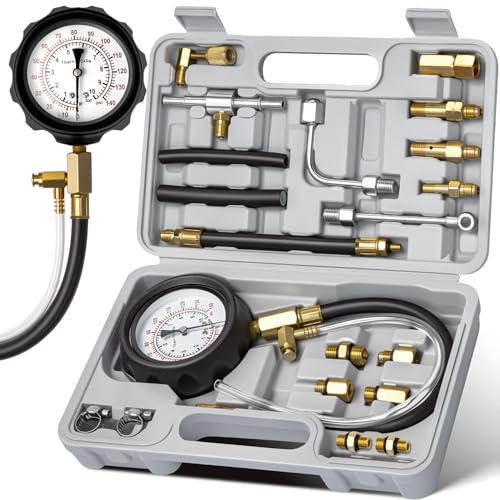
BETOOLL 0-140PSI Fuel Injector Injection Pump Pressure Tester Gauge Kit Car Tools (Master)
$30.99 Check pricePrices change often - TOPDON
TOPDON Carpal OBD2 Scanner Bluetooth - All System Diagnostic Tool with AI
- full system
- wireless
$40.99 Check pricePrices change often - LEE-3
LEE-3 OBD2 Bluetooth Scanner Engine AT ABS SRS Four-System Code Reader
- ABS + SRS
- wireless
$54.00 Check pricePrices change often - Solary
Solary Automotive Smoke Machine Leak Detector - 12V DC EVAP Vacuum Diagnostic Tester for Pipe System
$58.99 Check pricePrices change often


Common questions
What is a normal fuel trim reading?
Total fuel trim, meaning short term plus long term added together, should sit within about plus or minus 10 percent on a healthy engine at operating temperature. Small corrections are normal and expected, because the computer is constantly trimming against fuel quality, altitude and wear. It is sustained correction beyond 10 percent that indicates a fault.
What is the difference between short term and long term fuel trim?
Short term fuel trim is the immediate correction the computer is making right now in response to the oxygen sensor, and it moves constantly. Long term fuel trim is the learned average it has stored, which shifts slowly as the short term correction stays in one direction. Long term carrying a large value means the condition has been present for a while.
Why is fuel trim high at idle but normal at cruise?
Because a vacuum leak admits a roughly fixed volume of air. At idle the engine is drawing very little air, so a fixed leak is a large proportion of the total and forces a big correction. At cruise the engine draws far more air, the same leak becomes a small proportion, and the correction falls away. That pattern is close to diagnostic on its own.
Can a bad oxygen sensor cause high fuel trim?
Yes, and it is one of the harder cases because the sensor is the thing reporting the problem. An upstream sensor that reads lean when the mixture is correct makes the computer add fuel it does not need. Checking the sensor against a known good reading, or comparing banks on a V engine, is how that gets separated from a real mixture fault.
Do I need a special scanner to read fuel trim?
You need one that streams live data, which rules out the cheapest code readers. Any full system scanner or a good phone dongle with a capable app will show short and long term fuel trim as standard parameter identifiers. Graphing helps a great deal, because watching the value move as engine speed changes is what reveals the pattern.