Best automotive borescopes
Quick answer
The Anykit 210° Two-Way Articulating Borescope at $68.99 is the best pick for most DIYers because its articulating tip can steer around an obstruction inside a cylinder or intake, which a fixed straight probe cannot do.

Anykit 210° Two-Way Articulating Borescope, 0.22in Slim Probe Endoscope
At $68.99, the Anykit 210° Two-Way Articulating Borescope has a slim 0.22-inch probe that steers around obstructions, letting it inspect cylinder walls, intake ports and tight spaces a fixed straight-probe camera cannot reach.
Coverage varies by tool and by model year, so check a specific tool against a specific vehicle before buying.
The three tiers
Beginner: Best first inspection camera
Who it is for: someone doing an occasional visual check of a cylinder, intake port or hard-to-reach area
- Beginner pick
Daxiongmao Endoscope Camera with Light, 1080P HD Borescope
$28.49 Check pricePrices change often

The Daxiongmao 1080P borescope at $28.49 provides an HD camera with built-in light for a fraction of the price of an articulating model, which is enough for a straightforward visual check where the camera can be aimed by hand without needing to steer around an obstruction.
Not for: anyone inspecting a curved or obstructed path, such as looking around a valve or into an angled port, since this probe does not articulate.
Intermediate: Best all-around borescope for automotive work
Who it is for: a DIYer inspecting cylinders, intake runners or tight mechanical spaces that require steering the camera tip
- Intermediate pick
Anykit 210° Two-Way Articulating Borescope, 0.22in Slim Probe Endoscope
$68.99 Check pricePrices change often
The Anykit 210° Two-Way Articulating Borescope at $68.99 has a slim 0.22-inch probe that steers to look around an obstruction, which matters for inspecting piston tops, valve faces or intake ports at an angle a straight probe cannot reach.
Not for: someone needing dual-lens forward and side viewing in one pass, since this is a single-lens articulating design.
Expert: Best borescope for demanding inspection work
Who it is for: someone doing detailed inspection work across automotive and other mechanical applications who wants dual-lens coverage
- Expert pick
DXZtoz Dual-Lens Articulating Borescope for Aircraft Automotive Inspection
$159.99 Check pricePrices change often
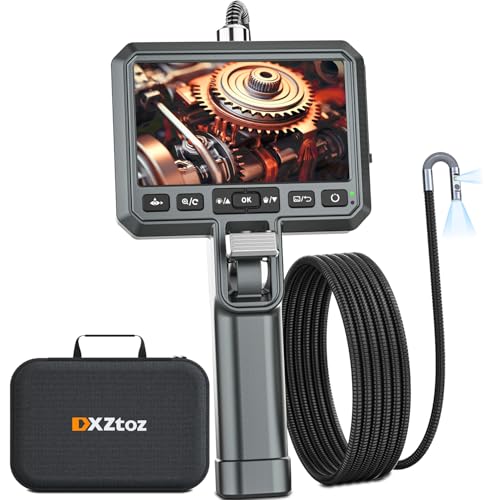
The DXZtoz Dual-Lens Articulating Borescope at $159.99 is built for both aircraft and automotive inspection use, adding a second lens angle to capture more of a confined space in a single pass than a single-lens articulating probe.
Not for: someone doing a single occasional inspection. The beginner or intermediate tier covers a one-time cylinder check for a fraction of the cost.
| Borescope | Price | Capability | Best for |
|---|---|---|---|
| Daxiongmao 1080P | $28.49 | Fixed straight probe, HD, light | Simple direct-view inspection |
| TGJOR Dual-Lens | $37.99 | Dual-lens, 16.4ft cable | Longer-reach inspection |
| Anykit 210° Two-Way | $68.99 | Articulating, 0.22in slim probe | Steering around obstructions |
| FOXWELL Y400 | $115.99 | 220° 2-way articulating, ultra-slim | Narrow, tight-space inspection |
| DXZtoz Dual-Lens Articulating | $159.99 | Dual-lens, articulating, aircraft-grade | Detailed, demanding inspection work |
What can a borescope inspect that you cannot see otherwise?
A borescope lets you visually inspect the inside of a cylinder through the spark plug hole, look inside an intake manifold or throttle body for carbon buildup, check behind components without disassembly, or peer into a tight mechanical space that would otherwise require significant teardown to access visually.
This is purely a visual inspection tool; it does not measure anything electrically or mechanically the way a compression tester or multimeter does, but it can confirm or rule out a suspected physical problem, such as carbon buildup, a foreign object, or visible cylinder wall damage, without pulling the engine apart.
Straight probe versus articulating tip
A fixed straight probe only shows what it is physically aimed at, which is fine for a direct line of sight, such as looking straight down a spark plug hole at the top of a piston. An articulating tip can be steered, typically with a small joystick or lever on the handle, to look around a corner or angle the camera toward a specific feature, such as the underside of an intake valve.
For most simple checks, a straight probe is enough and costs less. For thorough inspection work where the area of interest is not directly in line with the insertion point, articulation is worth the extra cost.
- Straight-down spark plug hole inspection: a fixed probe works fine
- Checking a valve face or an angled intake port: articulation is needed
- Inspecting a long, curved path such as inside ductwork or behind a panel: articulation with sufficient cable length is needed
Is a dual-lens borescope worth the extra cost?
A dual-lens design captures a wider field of view or a second angle in a single pass, which can save time during a detailed inspection compared to repositioning a single-lens probe repeatedly. For an occasional single inspection, this convenience matters less than for someone doing detailed inspection work regularly across multiple areas of an engine or vehicle.
How long a cable do I need for automotive inspection?
For most engine-bay tasks, such as inspecting a cylinder through a spark plug hole or checking an intake manifold, a cable in the 3 to 6 foot range is generally sufficient. Longer cables, such as the roughly 16-foot option in this roundup, matter more for reaching into larger or more distant spaces, such as tracing a longer duct or a fuel tank interior, rather than typical engine inspection work.
A longer cable is rarely a disadvantage beyond slightly more awkward handling in a tight engine bay, so if you are unsure, a mid-length cable that covers both close and moderately distant inspection needs is a reasonable default.
How we chose
This roundup is researched from published manufacturer specifications and listing descriptions across our catalog, not from hands-on testing of every unit. Resolution, probe diameter, articulation angle and lens count referenced here come directly from what each product listing states.
The single biggest capability difference among automotive borescopes is articulation: whether the tip can be steered remotely to look around an obstruction, versus a fixed straight probe that only sees what it is physically pointed at. We organized this roundup around that distinction since it determines what kind of inspection job a given borescope can actually complete.
Probe diameter matters for reaching a spark plug hole or a narrow gap without modification; check the listed probe diameter against your specific application, such as a spark plug hole size, before assuming any borescope will physically fit.
Buying tips
Do I need an articulating tip or is a straight probe enough?
A straight probe is fine for inspecting something you can point the camera at directly, such as looking straight down into a spark plug hole at a piston top. An articulating tip is necessary when you need to look around a corner or an obstruction, such as checking the back side of a valve or an intake port at an angle.
What probe diameter fits a spark plug hole?
Most spark plug holes comfortably fit a probe under roughly 0.25 inches in diameter, but this varies by engine. Check the listed probe diameter against your specific spark plug thread size before buying if that is the primary use case.
Does resolution matter for automotive inspection?
Higher resolution matters most when trying to spot fine detail, such as light carbon buildup versus a hairline crack on a valve face. For a general visual check of major damage or debris, a lower resolution camera is often sufficient, but 1080P has become a common and affordable baseline that handles most inspection needs well.
Other options worth knowing about
- FOXWELL
FOXWELL Y400 220° 2-Way Articulating Borescope, 0.24in Ultra-Slim Endoscope
$115.99 Check pricePrices change often - Teslong
Teslong Articulating Borescope for Mechanic Automotive HVAC Wall Inspection
$129.99 Check pricePrices change often


Common questions
Can a borescope tell me if my engine has internal damage?
A borescope can show visible damage, such as scoring on a cylinder wall, a bent valve, or significant carbon buildup, when inserted through an accessible opening like a spark plug hole. It cannot measure mechanical health the way a compression test can, so the two tools are often used together for a fuller picture.
What size probe do I need to fit a spark plug hole?
Most spark plug holes accept a probe under roughly 0.25 inches in diameter, but this varies by engine design. Check the specific probe diameter listed for a borescope against your engine's spark plug thread specification before buying if that is your intended use.
Do I need an articulating borescope for automotive work?
Only if you need to look around a corner or an obstruction rather than straight ahead. For a direct-line inspection, such as looking straight down a spark plug hole, a fixed straight probe works fine and costs less than an articulating model.
What resolution borescope is good enough for automotive inspection?
1080P has become a common and affordable baseline that shows clear detail for most inspection needs, including carbon buildup, cylinder wall condition and valve appearance. Higher resolution helps mainly when trying to spot very fine detail, such as distinguishing light carbon deposits from an actual hairline crack.
Can I use an automotive borescope for other inspections around the house?
Many borescopes marketed for automotive use are general-purpose inspection cameras and work fine for plumbing, HVAC ductwork or other tight-space inspection tasks, as long as the cable length and probe diameter suit the application.